Metadata
aliases: []
shorthands: {}
created: 2021-10-31 15:45:37
modified: 2022-06-05 19:33:10
In a Bravais lattice, a lattice plane can be exactly determined using three noncolinear lattice points. Due to the translational symmetry, we can use only three integers
A lattice plane described by these
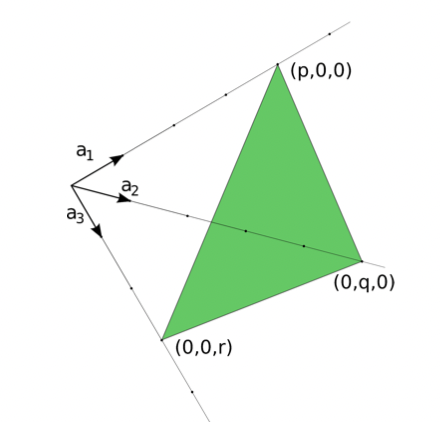
These indices can be gathered by choosing the closest plane to the origin, then find the intersection points along the lines of the primitive vectors:
A given
We can describe a lattice plane set instead of the
We take the smallest possible
These new indices are called the Miller indices of the lattice plane set.
Let's consider a lattice plane with Miller indices
This means that we can describe a lattice plane set with a given direction using a reciprocal lattice vector. (Note: different reciprocal lattice vectors describe different lattice plane sets if they are not a scalar-multiple of each other (they are not linearly dependent)).
Let's consider two neighboring planes in a lattice plane set with numbers
This is the distance between neighboring planes in the lattice plane set of Miller indices
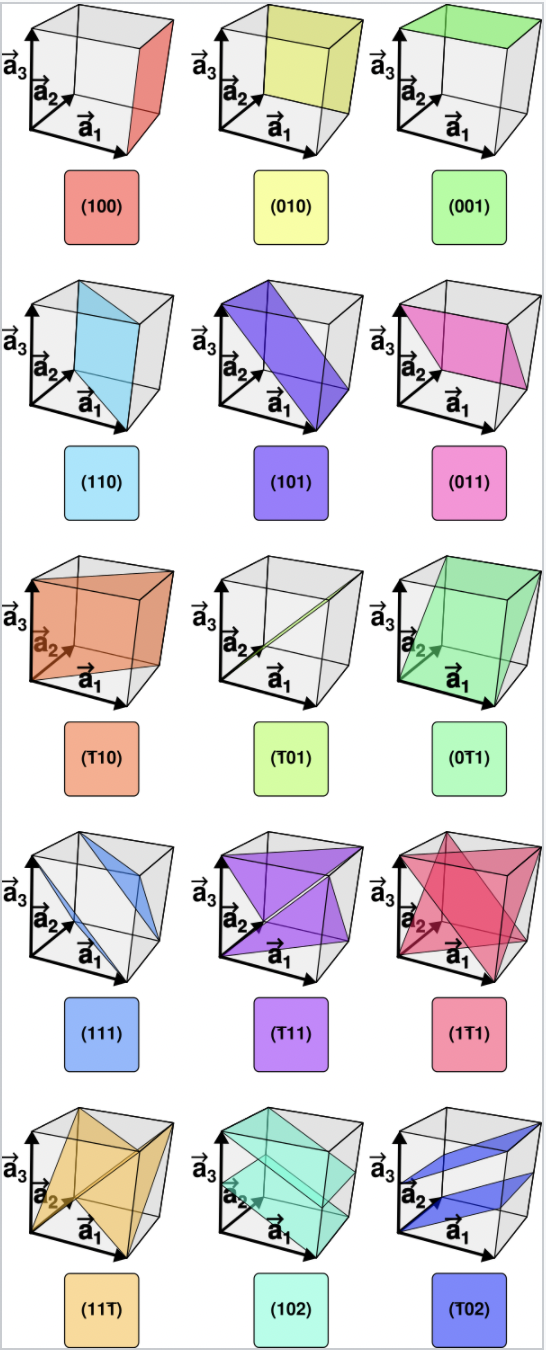
Lattice planes with different Miller indices in cubic crystals: